


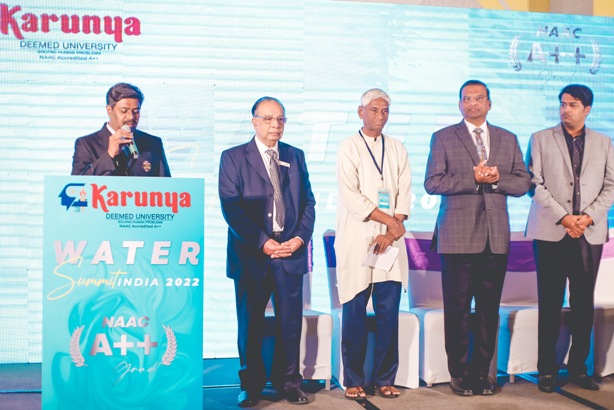
Karunya Institute of Technology and Sciences conducted a Water Summit on 17.09.2022 at Welcomhotel, Coimbatore, inviting many eminent scientist and academicians of the country who are working on solving various problems related to water. A Coimbatore declaration was proposed by the experts at the conclusion of the event, which is expected to be forwarded to the Government of India.
Dr. Paul Dhinakaran, the Chancellor of Karunya Deemed University presided over the function and mentioned that it is privilege to serve the humanity in every possible way. He thanked the external experts, participants and well-wishers who have gathered in the summit to discuss and deliberate on the problems related to water which is one of the important and a finite resource in the world. He told the gathering about his vision for Karunya and how the University started to focus on the four thrust areas, namely, Water, Food, Sustainable Energy and Healthcare. He also specified that Karunya has signed MoUs with Israeli Universities like Ben-Gurion University, Technion, Tel Aviv, etc. and established a Water Institute. Dr. Paul Dhinakaran inaugurated a Water Museum at Karunya Campus in the presence of the delegates and authorities of the University.
The delegates discussed various problems and came out with a 20-point agenda to solve the water crisis of the country. The details are given below:
1) Summit recognizes the need for Integrated Water Resources Management, optimizing the water allocation and use by the stakeholders.
2) The need for Integrated Data Management System and accessibility of the data by all stakeholders involved is emphasized. Infrastructure and the system for data collection has to be installed.
3) There should be an integration of land, water, energy, food, health for optimal
utilization of natural resources.
4) Appropriate institutional mechanisms to be developed to take care of the river basins.
5) Water to be considered as a common pool of resource to the society for unified governance. Acts and laws that can address the plan in a rational way for an equitable water regime in the country have to be evolved.
6) The need for quantifying the impact of climate change on water resources and incorporating the impacts on national and state level plans.
7) The hydraulic structures may have to be designed and existing designs modified, if required, to incorporating the impact of climate variability and climate change.
8) Adequate climate resilience or adaptation funding should be mobilized.
9) Scientific and integrated reservoir operation policies have to be evolved and implemented in an autonomous manner for informed and timely decision making to take care of both water conservation and flood mitigation measures to regulate floods.
10) While concentrating on the developmental aspects of water resources the ecological
developments have to be given equal importance.
11) There is a need for capacity building and awareness so as to make stakeholders
responsible.
12) Over exploitation of groundwater resources should be avoided and systematic monitoring of groundwater to be done on a periodic basis to avoid groundwater mining.
13) Rain water harvesting and recharge measures should be implemented considering hydrological potential and made mandatory whenever new construction is made. Land use planning should be in tune with hydrologic regimes.
14) Conjunctive use of surface and groundwater should be practiced in command areas.
15) Efficient water use in all sectors like irrigation/domestic/industry practices should be followed.
16) Anthropogenic and geogenic causes of contamination have to be studied and
appropriate measures should be taken.
17) The application of the Industry 4.0 ecosystem has to be introduced to a large extent in the water sector.
18) In the present and future urbanization plans and development of smart cities
integrated urban water management along with source diversification aspects should be considered.
19) R&D, training and extension should be given emphasis while planning future water resource management.
20) Education on water resources should be imparted from primary schooling onwards.